Understanding Cream Cake Decoration Types + How to Execute Advanced Techniques
Cream cake decoration is far more than a simple beautification step; it is an essential part of the professional pastry-making process. The appearance of a cake is the first thing a customer or guest interacts with, and in many cases, the quality of the decoration plays a decisive role in how the cake’s value is perceived.
From basic techniques like creating rosettes and swirl lines to advanced styles such as watercolor designs, sharp edges, or mixed decorations with cream fondant, every detail reflects the pastry chef’s skill level and precision.
In this article, we will first familiarize ourselves with the basic principles of cream cake decoration, then move on to more complex and modern techniques. We will also explore professional tools, color combination principles, and methods for decorating custom birthday cakes to provide a complete guide for students and professional pastry chefs.
Why is Cream Cake Decoration an Important Skill?
Cream cake decoration is a key skill in the art of pastry making. It not only serves an aesthetic purpose but also plays a vital role in increasing product value, attracting customers, and creating a distinction between ordinary and professional cakes. In today’s competitive world, the appearance of a cake can be the deciding factor for a customer, especially regarding event orders or celebration cakes.
✦ First Visual Impact: Before the taste of the cake is even experienced, its appearance is judged. Professional decoration creates a sense of trust and leads to a higher valuation of the product’s quality.
✦ Reflection of the Chef’s Skill and Creativity: The choice of colors, textures, techniques, and innovative combinations demonstrates the technical level and artistic taste of the pastry chef, serving as their personal “signature.”
✦ Customization and Orderability: Diverse decoration options allow the chef to design cakes tailored to the customer’s taste, the event theme, the season, or the occasion, creating a unique experience.
✦ A Factor for Market Differentiation: In a competitive market of homemade and industrial cakes, the quality of decoration can be your point of distinction. Pastry chefs with high decorating skills attract more loyal customers and receive more specialized orders.
Introduction to Basic Cream Decoration Techniques (Rosette, Linear, Swirl)
Before moving into advanced techniques, mastering basic cream decorations is essential for every student or chef. These techniques form the foundation for many more complex designs; learning them correctly increases precision, speed, and the final quality of the work.
✦ Rosette: One of the most common and beautiful decorative patterns. It is formed using a star tip and circular motions from the center outward. Rosettes are typically used for borders, full surface coverage, or decorating cupcakes. Creating a uniform rosette requires precise control of hand pressure and rotation.
✦ Straight and Broken Lines: One of the most fundamental exercises in cream decoration is drawing straight, curved, or broken lines with various tips. This technique is used for simple designs, writing text, or creating geometric patterns, and it strengthens hand skill in controlling cream thickness and direction.
✦ Swirl Patterns: These patterns are executed in a spiral motion from the inside out. They are often used on single-layer cakes, cupcakes, and side borders. This technique is performed using a round or star tip with a consistent, rotating motion.
✦ Other Basic Techniques:
Dotting: Creating regular dots for background textures or shaping petals.
Piping Borders: Creating cream strips of various thicknesses on borders or the cake surface.
Surface Filling: Using cream to cover the full or half surface of the cake, either smoothly or with texture.
Advanced Decoration Techniques: Sharp Edge, Watercolor, and Ombre/Shading
Once basic techniques are mastered, a student can move on to more advanced techniques used in modern, minimal, or customized cakes. These techniques require high precision, appropriate tools, and skill in cream control, and are often used in celebration, wedding, or fashion cakes.
✦ Sharp Edge: This refers to a state where the edges of the cake are perfectly smooth and angular, without any rounding or unevenness. This style offers a very professional and modern look, often used in monochrome or minimal cakes.
Key tips for execution: Use a dedicated sharp-edge scraper and a turntable with controlled speed; chill the cake before applying the final cream; use precise layering with properly stabilized cream.
✦ Watercolor Effect: In this style, multiple colors of cream are spread across the cake in layers or strokes to create an effect similar to a watercolor painting. A palette knife, brush, or scraper can be used.
Application: Highly suitable for artistic birthday cakes, fantasy themes, or special photography.
✦ Ombre / Shading: In this technique, the color of the cream is applied gradually from dark to light (or vice versa). Using a piping tip or a scraper, the color is spread in layers and gently blended with the other color.
Example: Cakes with a color gradient from deep purple to light lilac, or deep blue to white.
Color Combination Education for Special Cakes
Colors are one of the most important visual elements in cake design and decoration. A good color combination can make your cake look eye-catching, elegant, and appropriate for the occasion, while a poor choice can result in an unprofessional look, even with strong technique.
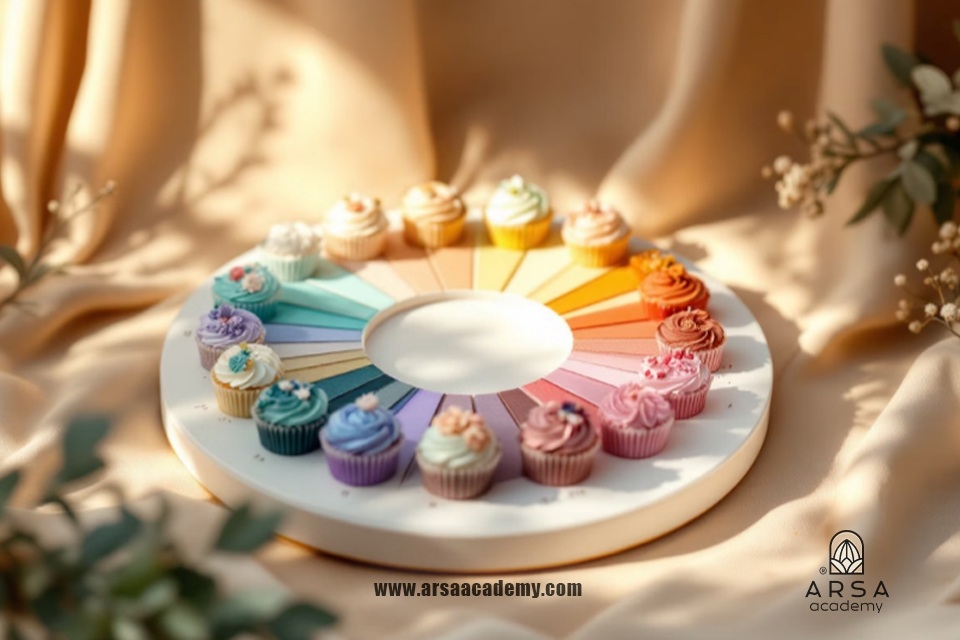
✦ Understanding the Color Wheel: To create successful combinations, familiarity with the color wheel is essential. Complementary, analogous, and contrasting colors can all create beautiful harmony or contrast when used intelligently.
Complementary Colors: Such as blue and orange – they create high-energy contrast.
Analogous Colors: Such as green, blue, and turquoise – they are harmonious and calming.
Monochromatic: Using different shades of a single color – ideal for minimal and chic cakes.
✦ Color Psychology in Occasions:
Pink and Lilac: Suitable for children’s birthdays and feminine themes.
Gold and Black: For luxury and adult cakes.
White and Mint Green: For wedding themes, simple, and natural styles.
Vivid Colors (Red, Orange, Purple): For energetic or artistic themes.
✦ How to Combine Colors in Cream: To create color gradients in cream, edible gels or specialized pastry powder colors are used. Color should be added gradually and must be tested before use, as cream tends to darken slightly over time.
Techniques: Direct coloring in the cream and spreading in layers; blending colors on the surface with a scraper for artistic effects; striped piping using multi-color tips; and using professional tools (nozzles, palettes, stencils, etc.).
Professional Decorating Tools
Decorating tools in professional cake making are like brushes in the hands of a painter. Familiarity with these tools and their correct use increases the precision and elegance of the work, enabling the execution of advanced and creative designs.
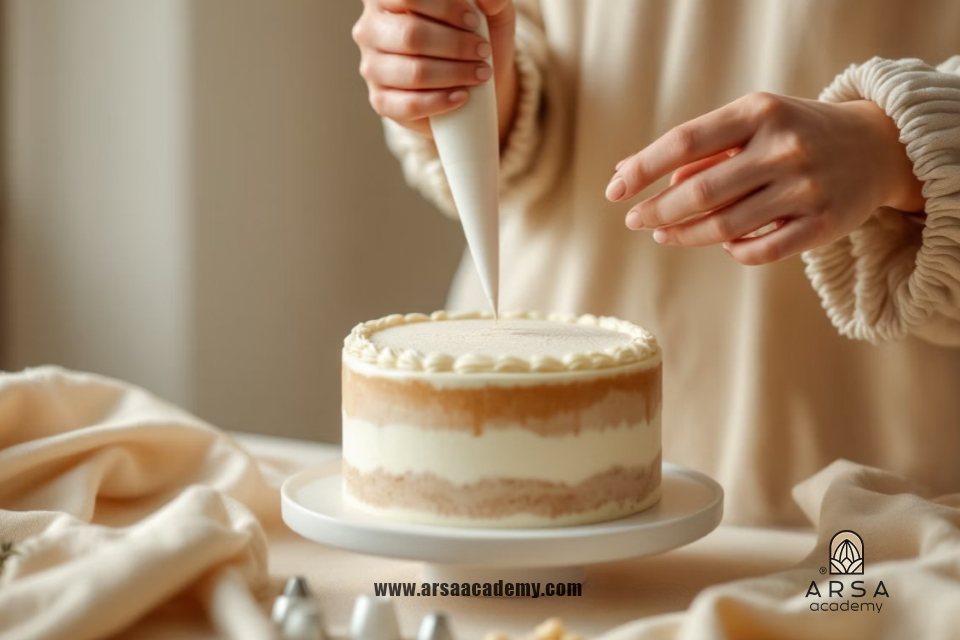
✦ Tips (Nozzles): The primary tools for shaping cream. They come in various shapes and sizes:
Open and Closed Star Tips: For rosettes, swirls, and classic flowers.
Round Tips: Suitable for simple lines, writing, and dotting.
Leaf and Petal Tips: For designing natural flowers.
Russian Tips: For creating voluminous flowers with a single squeeze.
Working with tips requires practice in controlling pressure and hand angle to ensure cream is placed evenly and beautifully.
✦ Palette and Straightening Scraper: Essential for smoothing the surface and edges of the cake. These tools play a key role in creating a uniform surface and sharp edges and are often used alongside a turntable.
✦ Turntable: One of the most important tools for any pastry chef. It allows for the uniform rotation of the cake, making it easier to decorate evenly from all sides.
✦ Stencils and Edible Sprays: To create precise and clean designs, stencils can be used with powdered sugar, cocoa powder, or edible color sprays. This method is suitable for minimal designs, logos, or graphic patterns.
Stencil and Precision Techniques:
Choose a proper stencil: Select one that matches your desired design.
Prepare the cake surface: The surface must be completely smooth and dry so the stencil sits correctly and the design remains clean.
Execute the design: Hold the stencil firmly against the cake and spread the powder or spray with uniform motions.
Remove the stencil: Lift the stencil carefully and slowly to avoid ruining the design.
How to Make a Birthday Cake Special and Custom
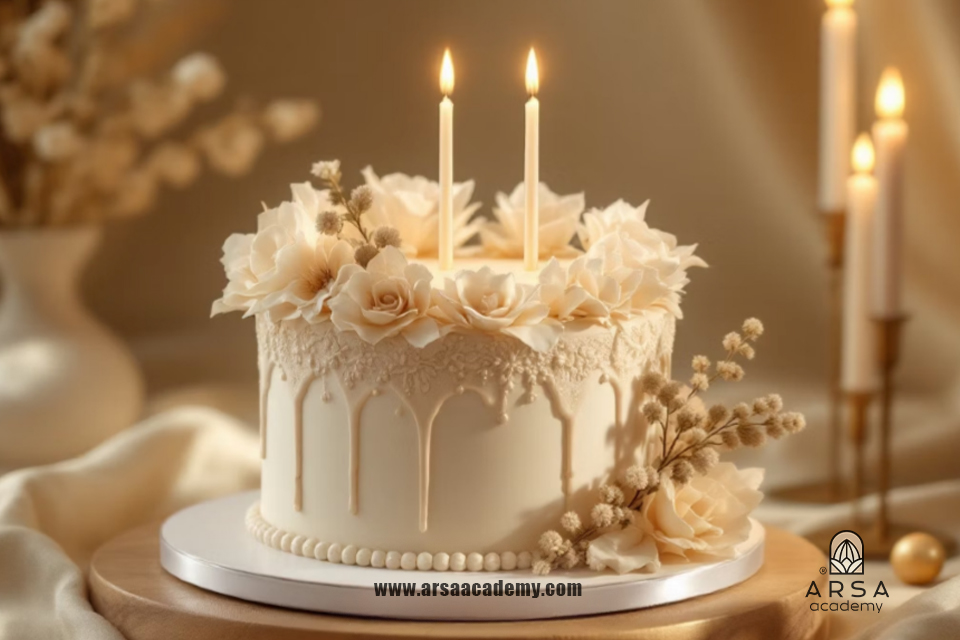
Decorating a birthday cake is a golden opportunity to showcase creativity and respond to the specific tastes of each customer. Custom design, in addition to visual beauty, conveys a sense of personalization and uniqueness, which is especially important for special occasions.
✦ Understanding Tastes and Event Themes: Before starting, it is best to discuss color themes, interests, personality, and the style of the event with the client. This information helps you create a design that is harmonious and consistent with the environment and wishes.
✦ Using Personalized Elements:
Names or Custom Messages: Written using round tips or fondant molds.
Shapes and Symbols: Designing specific shapes like animals, flowers, cartoon characters, or special symbols.
Combining Materials: Using a mix of cream, fondant, chocolate, edible flowers, and decorative tools to create depth and appeal.
✦ Choosing Special Color Combinations: Matching colors to the individual’s taste and the event theme is the key to visual harmony. Bright and diverse colors are better for children, while soft and elegant colors are more suitable for adults.
✦ Special Decoration Techniques: Using advanced techniques such as sharp edges, watercolor, shading, or even adding gold and silver details makes the cake truly unique.
Conclusion: The Importance and Execution of Advanced Cream Decorations
Cream cake decoration goes beyond mere beautification; it is an inseparable part of the art of professional pastry making. In this article, we explored the importance of decorating skills, basic and advanced techniques, color combinations, specialized tools, and methods for customizing birthday cakes.
Mastering basic techniques like rosettes and simple lines provides a strong foundation for moving into advanced methods like sharp edges, watercolor, and shading. Furthermore, choosing the right colors and using professional tools wisely elevates the quality of your work to a professional level.
Arsa Academy’s Skill-Oriented Modern Cream Cake Course, with its training on specialized decorations and professional tools, prepares you to create unique and custom cakes.